
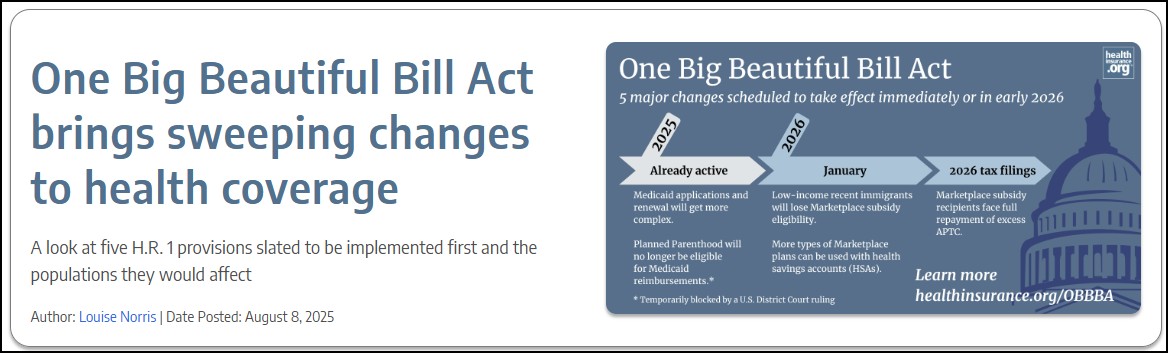
One Big Beautiful Bill Act (OBBBA), a reconciliation package that includes a broad array of tax provisions affecting individuals, businesses and international taxpayers.
We want to highlight the key provisions and offer preliminary insights into how they may affect your tax planning. Please contact us at your earliest convenience to discuss your situation so we can develop a customized plan. We will continue to closely monitor any potential regulatory guidance as it’s developed from the IRS and update you accordingly.
Individual income tax provisions
- Permanent extension of lower tax rates and brackets: The OBBBA generally makes the tax rates enacted in 2017 in the Tax Cuts and Jobs Act (TCJA) permanent. An additional year of inflation adjustment is added for determining the dollar amounts at which the 12% rate bracket ends and the 22% rate bracket begins.
- Standard deduction: The nearly doubled standard deduction would be made permanent. Effective for 2025, the amounts are as follows:
Single & Married Filing Separately (MFS): $15,750 (indexed)
Head of Household (HoH): $23,625 (indexed)
Married Filing Jointly (MFJ): $31,500 (indexed) - Child Tax Credit: The nonrefundable child tax credit increases to $2,200 per child beginning in 2025 and the credit amount is indexed for inflation.
- Estate and gift tax exemption: The increased exemption is made permanent and raised to $15 million per individual ($30 million for married couples) in 2026, indexed for inflation.
- SALT deduction cap: The state and local tax (SALT) deduction cap is increased to $40,000 per household and would be phased out for taxpayers with modified adjusted gross income (MAGI) over $500,000. In 2030, the deduction will revert to $10,000.
- Charitable deduction for non-itemizers: An above-the-line deduction is added for charitable contributions that starts in 2026 ($1,000 for single filers, $2,000 for joint filers).
- No tax on tips and overtime: For 2025–2028, above-the-line deductions are created for qualified tips (in certain occupations) and for overtime premium pay, subject to income and occupation limitations.
- Enhanced deduction for seniors: For 2025–2028, a $6,000 deduction is available for seniors (age 65+) with income below $75,000 ($150,000 for joint filers).
- Car loan interest deduction: For 2025–2028, up to $10,000 of interest on loans for U.S.-assembled passenger vehicles may be deducted, subject to income phaseouts.
- Moving expense deduction: The deduction is permanently terminated except for those in the Armed Forces.
- Home mortgage interest and insurance premiums: The $750,000 limit on the treatment of mortgage insurance premiums as qualified residence interest is made permanent. The exclusion of home-equity indebtedness from the definition of qualified residence interest is also now permanent.
- Casualty loss deduction for personal casualties: The limitation on personal casualty loss deductions is made permanent, however a provision is added to include state-declared disasters.
- Other deductions and credits: Several other deductions and credits, including the adoption credit, employer-provided childcare credit, paid family and medical leave credit, and education-related benefits are made permanent.
- Personal Exemption: The personal exemption is permanently repealed.
- Charitable Deductions: The 60% annual gross income (AGI) limitation for cash contributions is made permanent (up from the pre-TCJA 50%). For itemizers, only contributions exceeding 0.5% of AGI are deductible, with special carryforward rules for amounts above the ceiling and below the floor. For taxpayers in the top 37% marginal income tax bracket, the value of charitable deductions is capped at 35%, effectively imposing a 2% tax on otherwise deductible contributions. Non-itemizers may now claim an above-the-line charitable deduction of up to $1,000 (single) or $2,000 (joint). For those wishing to make sizable charitable gifts, consider accelerating to complete in 2025 before these new limitations take effect; non-itemizers, however, should consider holding tight until 2026 to benefit from the new above-the-line charitable deduction.
- State and Local Tax (SALT) Deduction Cap: The cap on SALT deductions increases from $10,000 to $40,000 for 2025-2029, with a phase-out for modified AGI between $500,000 and $600,000. Both the cap and phase-out thresholds increase by 1% annually. The pass-through entity tax (PTET) “workaround” remains available in states that have enacted it.
- Itemized Deduction Limitation: Beginning in 2026, the value of itemized deductions is capped at 35%, creating a 2% tax on itemized deductions for those in the top bracket. The suspension of miscellaneous itemized deductions (e.g., investment management and tax preparation fees) is made permanent.
- Top Marginal Tax Rate: The 37% top federal income tax rate for individuals is made permanent, preventing the scheduled reversion to the pre-TCJA 39.6% rate in 2026. For tax year 2026, the top tax rate remains 37% for individual single taxpayers with incomes greater than $640,600 ($768,700 for married couples filing jointly). Estates and complex trusts are subject to the top 37% rate with income in excess of $16,000. The capital gains rate structure is also permanently retained, with the 15% rate kicking in at $49,451 for individual single taxpayers ($98,901 for married couples filing jointly) and the 20% rate kicking in at $545,500 for individual single taxpayers ($613,700 for married couples filing jointly)
- Alternative Minimum Tax (AMT): The higher AMT exemption amounts and phase-out thresholds established by the TCJA are made permanent. For tax year 2026, the exemption amount for unmarried individuals is $90,100 and begins to phase out at $500,000 ($140,200 for married couples filing jointly for whom the exemption begins to phase out at $1,000,000). The phase-out threshold will be indexed for inflation beginning in 2027.
- Standard Deduction: The increased standard deduction is permanently extended and enhanced. Taxpayers aged 65 and older receive an additional $6,000 through 2028. The increased standard deduction will be indexed for inflation beginning in 2027
- New and Enhanced Savings Vehicles Trump Accounts: The OBBBA introduces “Trump Accounts,” a new federal tax-deferred savings vehicle for children, starting in July 2026. Children born between January 1, 2025, and December 31, 2028, with a valid Social Security number, receive a one-time $1,000 government contribution. Contributions by individuals are limited to $5,000 per year (indexed), with employers able to contribute up to $2,500 per year (also indexed), subject to the overall cap. Earnings grow tax-deferred; contributions are after-tax and not deductible. Investments must be in low-cost US katten.com index-tracking funds. Distributions are prohibited before age 18. Following age 18, the account starts to look and function much more like a traditional IRA.
- 529 Plan Enhancements: Annual distribution limits from 529 Plans for elementary, secondary or religious school expenses increase to $20,000 (from $10,000) beginning after December 31, 2025. The definition of qualifying expenses is expanded to include a broader range of educational costs, including tuition, materials, tutoring, standardized test fees and educational therapies for students with disabilities.
Standard deduction Increases
Tax year 2025
- $31,500 for married couples filing jointly
- $15,750 for single filers and married individuals filing separately
- $23,625 for heads of household
Tax year 2026
- $32,200 for married couples filing jointly
- $16,100 for single filers and married individuals filing separately
- $24,150 for heads of household
Estate tax exclusion for tax year 2026
- Basic exclusion amount is $15,000,000
- Up from $13,990,000 for 2025 decedents
Adoption credit limits for tax year 2026
- Maximum adoption credit is $17,670, which is higher than the $17,280 limit for 2025.
- Up to $5,120 of this credit may be refundable.
Employer-provided childcare credit expansion for tax year 2026
- Maximum amount increases from $150,000 to $500,000
- Maximum increase to $600,000 if employer is an eligible small business
Deduction for seniors (Section 70103)
Overview of the deduction
- Effective 2025 through 2028, individuals age 65 and older may claim an additional $6,000 deduction.
- This is in addition to the standard deduction for seniors available under existing law.
- Applies per eligible individual (or $12,000 for a married couple if both spouses qualify).
- Phases out for taxpayers with modified adjusted gross income over $75,000 ($150,000 for joint filers).
Who qualifies
- You must be age 65 on or before the last day of the tax year.
- Available for eligible taxpayers (both itemizing and non-itemizing).
How to claim the deduction
- Include your Social Security number on the return.
- File jointly, if you’re married.
No tax on tips (Section 70201)
- Effective 2025 through 2028, employees and self-employed individuals may deduct qualified tips they received in occupations the IRS identified as “customarily and regularly receiving tips” on or before December 31, 2024, and are reported on a Form W-2, Form 1099, another statement furnished to the individual, or on Form 4137 if the individual directly reports the tips.
- “Qualified tips” include voluntary cash or charged tips received from customers, including shared tips.
- Maximum annual deduction is $25,000.
- For self-employed individuals, deduction cannot exceed net income (before this deduction) from the trade or business where tips were earned.
- Phases out for taxpayers with modified adjusted gross income over $150,000 ($300,000 for joint filers).
Who qualifies:
Individuals who:
- Have a Social Security number (SSN)
- Claim itemized or non-itemized deductions
Who doesn’t qualify
Individuals who are:
- Self-employed in a Specified Service Trade or Business (SSTB) under Section 199A
- Employees of an employer in an SSTB
How to claim the deduction
- Include your Social Security number on the return
- File jointly if you’re married
Reporting requirements
- Employers and other payors must report certain cash tips and the occupation of the tip recipient on IRS (or SSA) information returns.
- Treasury and IRS will provide penalty relief for tax year 2025.
No tax on overtime (Section 70202)
Overview of the deduction
- Effective 2025 through 2028, individuals may deduct the portion of qualified overtime pay that exceeds their regular rate of pay (for example, the “half” portion of “time-and-a-half”).
- Overtime must be reported on Form W-2, Form 1099, another statement furnished to the individual, or directly by the individual.
- Maximum annual deduction is $12,500 ($25,000 for joint filers).
- Phases out for taxpayers with modified adjusted gross income over $150,000 ($300,000 for joint filers).
Who qualifies
Taxpayer who:
- Have a Social Security number (SSN)
- Claim itemized or non-itemized deductions
How to claim the deduction
- Include your Social Security number on the return.
- File jointly if you’re married.
Reporting requirements
- Employers and other payors must report qualified overtime compensation on IRS (or SSA) information returns.
- Treasury and the IRS will provide transition relief for tax year 2025.
No tax on car loan interest (Section 70203)
Overview of the new deduction
- Effective 2025 through 2028, individuals may deduct interest paid on a loan used to purchase a qualified vehicle for personal use that meets other eligibility criteria. Lease payments do not qualify.
- Maximum annual deduction is $10,000.
- Phases out for taxpayers with modified adjusted gross income over $100,000 ($200,000 for joint filers).
What counts as qualified interest
Interest must be paid on a loan that:
- Originated after December 31, 2024
- Was used to purchase a vehicle originally used by the taxpayer
- Was secured by a lien on the vehicle
- Was for a personal-use (nonbusiness) vehicle
If a qualifying vehicle loan is later refinanced, interest paid on the refinanced amount is generally eligible for the deduction.
What counts as a qualified vehicle
A qualified vehicle is a car, minivan, van, SUV, pickup truck or motorcycle that:
- Has a gross vehicle weight rating of less than 14,000 pounds
- Underwent final assembly in the United States.
To verify final assembly, check one of these:
- The vehicle label at the dealership
- The vehicle identification number (VIN)
- The National Highway Traffic Safety Administration, NHTSA VIN Decoder (verify vehicle assembly location)
Who qualifies
- Available to both itemizing and non-itemizing taxpayers.
- You must include the VIN on your return for any year you claim the deduction.
Reporting requirements
- Lenders or other recipients of qualified interest must file information returns with the IRS and provide statements to taxpayers showing the total amount of interest received during the taxable year.
Health Savings Account expansion for participants (Section 71307)
Overview of changes and benefits
Telehealth and remote care services
- Telehealth and other remote care services can now be received before meeting a high-deductible health plan deductible.
- People can still contribute to their Health Savings Account (HSA) even after using telehealth before meeting the deductible.
- This rule is permanent for plan years starting on or after January 1, 2025.
Expanded eligibility for Bronze and Catastrophic plans
- Starting January 1, 2026, bronze and catastrophic health insurance plans are treated as HSA-compatible.
- This applies whether the plans are bought through an insurance exchange or not.
- This change makes more people eligible to contribute to an HSA, including individuals who previously could not because their plan did not meet the strict HDHP definition.
Direct primary care arrangements
- Beginning January 1, 2026, people enrolled in certain direct primary care (DPC) service arrangements may:
- Contribute to an HSA if they otherwise qualify.
- Use HSA funds tax-free to pay periodic DPC fees.
Trump Accounts under the Working Families Tax Cuts (Section 70204)
Overview of Trump Accounts
- Parents, guardians, or others can establish a Trump Account for an eligible child.
- Trump Accounts cannot be funded before July 4, 2026.
- The federal government will make a one-time $1,000 contribution for each eligible child’s account.
- Authorized contributions from individuals and employers are allowed up to $5,000 per year.
- Employers can contribute up to $2,500 per year toward an employee’s or dependent’s Trump Account without it counting as taxable income for the employee.
- Funds must be invested in certain mutual funds or exchange-traded funds that track a U.S. stock index such as the S&P 500.
Withdrawal and use
- Generally, money cannot be withdrawn before the year the child turns 18.
- After that point, the account is treated like a traditional IRA with similar tax rules.
Overview of the change
- Beginning tax years after December 31, 2024, up to $5,000 (indexed for inflation) of the adoption credit may be refundable.
- Any credit amount carried forward from prior years cannot be used to calculate the refundable portion.
Business tax provisions
- QBI deduction: The qualified business income (QBI) deduction is made permanent and the deductible amount for each qualified business would remain at 20%.
- Bonus depreciation: 100% expensing (bonus depreciation) for qualified property is restored for property placed in service after Jan. 19, 2025.
- Sec. 179 expensing: The maximum amount a business may expense for qualifying expenses is increased to $2.5 million, with the phaseout threshold raised to $4 million, both indexed for inflation after 2025.
- R&E expenditures: Immediate deduction of domestic research or experimental expenses paid or incurred in 2025 is allowed. However, research or experimental expenses attributable to research that is conducted outside the United States will continue to be capitalized and amortized over 15 years.
- Excess business loss permanency: The excess business loss limitation is made permanent, and the existing treatment of loss carryforwards is maintained.
- Business interest deduction: The interest expense limitation is calculated using earnings before interest, taxes, depreciation and amortization (EBITDA), rather than earnings before interest and taxes (EBIT).
- FDII and GILTI: Beginning in 2026, the deduction percentage is reduced to 33.34% for foreign-derived intangible income (FDII) and 40% for global intangible low-taxed income (GILTI).
- BEAT: The base-erosion and anti-abuse tax (BEAT) rate is increased from 10% to 10.5%.
- Third-party network transaction reporting threshold: Form 1099-K, Payment Card and Third Party Network Transactions, reporting reverts back to previous rules where reporting is required if transactions exceed $20,000 and the aggregate number of transactions exceeds 200.
- Form 1099 reporting threshold: The information reporting threshold for payments for services increases to $2,000 in a calendar year (up from $600) in 2026, and the threshold amount will be indexed annually for inflation starting in 2027.
- Renewed Opportunity Zones: Opportunity zones provisions are made permanent, but with several changes, including narrowing the definition of “low-income community.” The changes will generally take effect in 2027.
- Clean energy and IRS credits: Several clean energy credits from the Inflation Reduction Act (IRA) are terminated.